PR Auto-Approver
Serverless GitHub App that auto-approves pull requests after CI passes, with optional AI code review via Amazon Bedrock. Five repositories: TypeScript/Probot app, AWS Terraform module (Lambda + API Gateway + Secrets Manager + SQS DLQ), GitHub Terraform module (webhooks), deployment infra, and test repo.
What it is
A serverless GitHub App that auto-approves pull requests when all CI checks pass. Optionally, before approving, it sends the diff to Amazon Bedrock for an AI code review that detects bugs, security vulnerabilities, and performance issues.
The project is split into five repositories with clear responsibilities:
| Repository | Version | Role |
|---|---|---|
| pr-auto-approver | v1.0.0 | TypeScript/Probot app — business logic (esbuild → ~1 MB) |
| terraform-aws-pr-auto-approver | v1.4.0 | Terraform AWS module — Lambda, API Gateway, Secrets Manager, SQS DLQ (Registry) |
| pr-auto-approver-infra | latest | Private deployment — consumes the modules, branch protected |
| pr-auto-approver-test | — | Test repo — PR history shows the bot in action |
| terraform-github-pr-auto-approver | v1.0.0 | Terraform GitHub module — per-repo webhooks (optional, the GitHub App configures them automatically) |
Architecture
Loading diagram...
Production demo
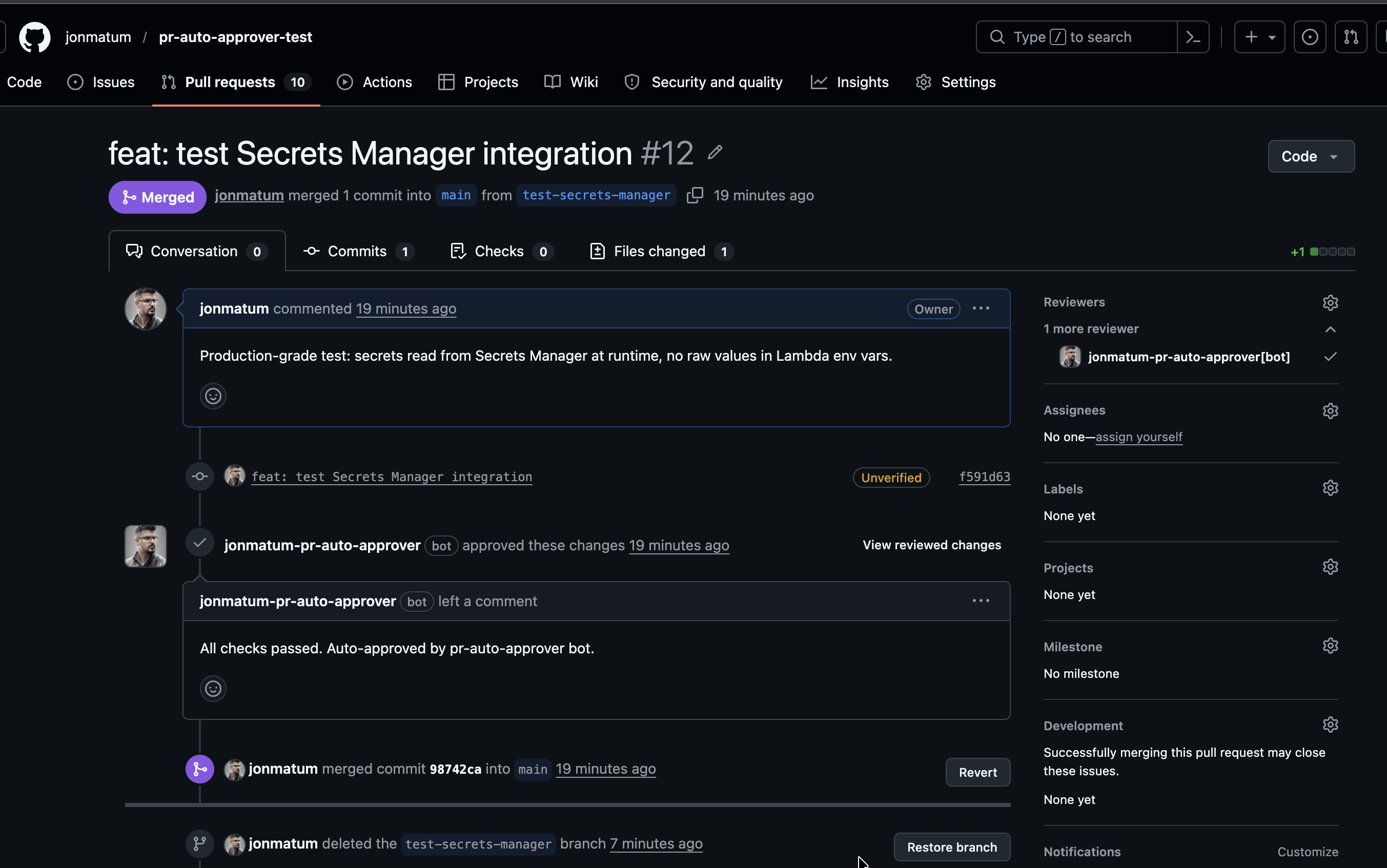
PR #21 shows the full AI review cycle. The first commit contained a hardcoded API key and a SQL injection vulnerability — the bot (jonmatumdev, using PAT) detected both issues, left inline comments, and requested changes. The author fixed the code, pushed a new commit, the bot automatically re-reviewed the updated diff, found no issues, and approved. The PR was merged — all in under two minutes.
How it works
The full flow from PR creation to approval:
- A PR is opened, a check suite completes, or new commits are pushed → GitHub sends a webhook
- API Gateway HTTP receives the POST and routes it to Lambda
- Lambda (Probot) validates the webhook HMAC signature using the secret from Secrets Manager
- Verifies the PR author is in the allowed authors list
- Waits for all check suites to complete successfully
- If Bedrock is enabled: sends the diff to the model for code review
- If the review finds no issues → approves the PR (via PAT if configured, or as GitHub App)
- If issues are found → posts review comments and requests changes
Security
Secrets management follows the principle of least privilege:
- The GitHub App private key, webhook secret, and optional approval token are stored in AWS Secrets Manager
- Lambda receives Secrets Manager ARNs as environment variables — raw values are never exposed
- On cold start, Lambda reads the secrets and caches them in memory for subsequent invocations
- When an
approval_token(PAT) is configured, the bot checks its validity on each cold start — logs CRITICAL if expired and WARNING if it expires within 14 days - The IAM role has
secretsmanager:GetSecretValuepermissions only for the specific ARNs - Bedrock permissions (
bedrock:InvokeModel) are added only whenbedrock_enabled = true - API Gateway throttling (burst: 10, rate: 5 req/s) to limit abuse
AWS module — resources created
The terraform-aws-pr-auto-approver v1.4.0 module creates:
| Resource | Configuration |
|---|---|
| Lambda | Node.js 20, 128 MB / 30s (no Bedrock), 256 MB / 120s (with Bedrock) |
| API Gateway v2 | HTTP API with POST route |
| Secrets Manager | 2-3 secrets (private key + webhook secret + optional approval token) |
| SQS Dead Letter Queue | 14-day retention, alarm on messages (failed webhooks) |
| IAM Role | Least-privilege, conditional Bedrock |
| CloudWatch Logs | 14-day retention |
| CloudWatch Dashboard | Lambda, API GW, Bedrock metrics (optional) |
| CloudWatch Alarms | Errors, throttles, high duration, 5xx, DLQ |
| SNS Topic | Email alerts (optional) |
| AWS Budget | Monthly Bedrock budget (optional) |
GitHub module — webhooks (optional)
The terraform-github-pr-auto-approver v1.0.0 module configures webhooks on each specified repository. This module is optional — when you install the GitHub App on a repository, webhooks are configured automatically. The module is only needed if you prefer to manage webhooks via IaC instead of the App's built-in webhook delivery.
module "approver_github" {
  source  = "jonmatum/pr-auto-approver/github"
  version = "~> 1.0"

  webhook_url         = module.approver_infra.webhook_url
  webhook_secret      = var.webhook_secret
  github_repositories = ["repo-one", "repo-two"]
}
It subscribes each repository to pull_request and check_suite events, pointing to the API Gateway endpoint.
Bedrock AI code review
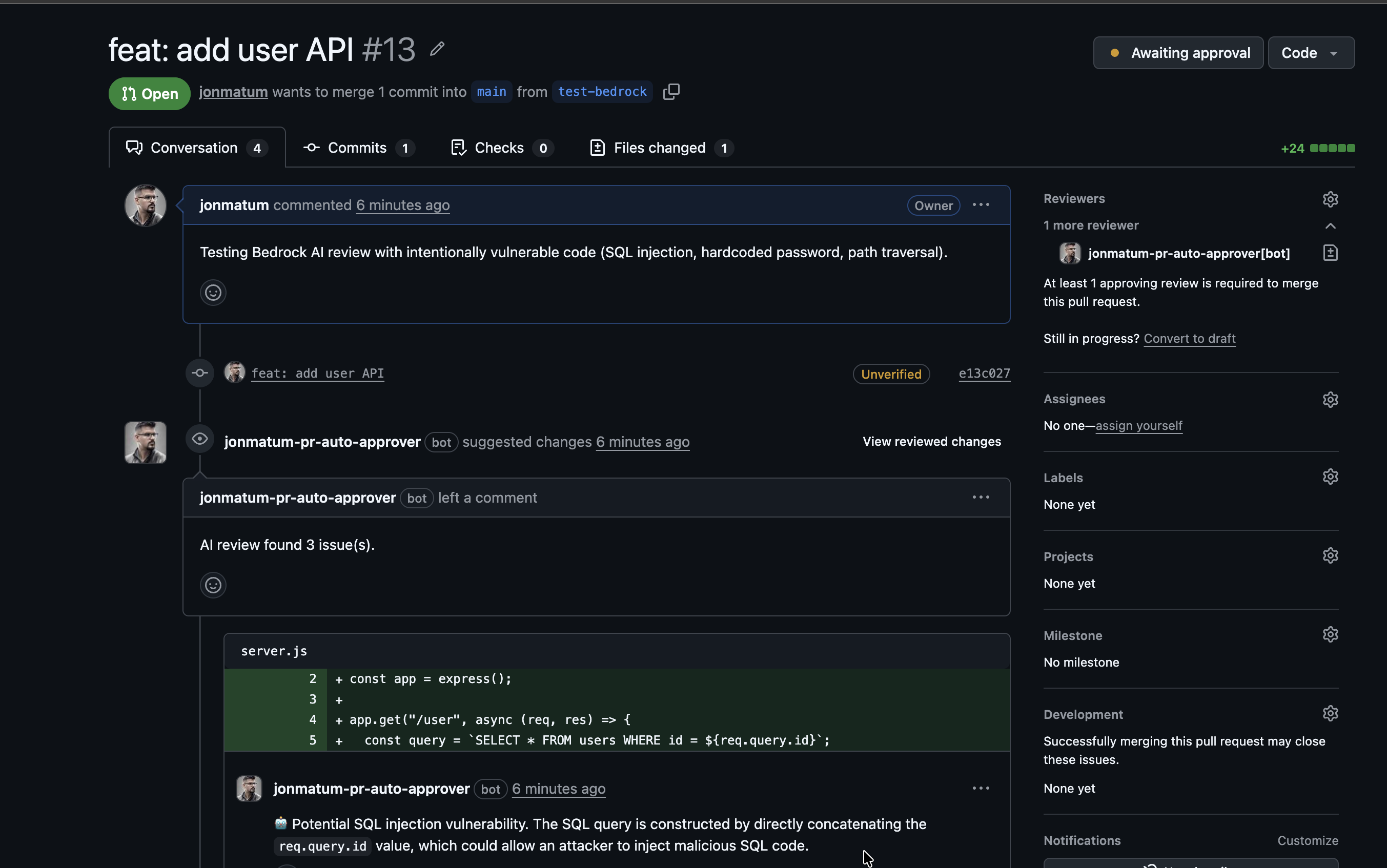
When bedrock_enabled = true, Lambda sends the PR diff to Claude 3.5 Haiku (configurable) before approving. In PR #21, the bot detected 2 issues in intentionally vulnerable code — a hardcoded API key and a SQL injection — and requested changes with inline comments instead of approving. The model reviews for:
- Bugs and logic errors
- Security vulnerabilities
- Performance issues
- Missing error handling
The review prompt was tuned to reduce false positives — the model only reports concrete issues, not style suggestions. If Bedrock is disabled or fails, the bot falls back to auto-approve after CI passes — the AI review never blocks the flow.
When new commits are pushed to an open PR, the bot dismisses its previous review (clears the "changes requested" state) and automatically re-runs the review on the updated diff.
Limitation: GitHub App approvals and branch protection
GitHub App approvals do not count as real user reviews in branch protection rulesets on the free plan. This means that even though the bot approves a PR, the "Require approvals" rule remains unsatisfied.
The implemented workaround is an optional approval_token — a Personal Access Token (PAT) stored in Secrets Manager. When configured, the bot submits the approval using that token instead of the GitHub App identity, which counts as a real user review and satisfies branch protection rules.
module "approver_infra" {
  source  = "jonmatum/pr-auto-approver/aws"
  version = "~> 1.4"

  # ... other variables ...
  approval_token = var.approval_token  # Optional PAT to satisfy branch protection
}
This limitation is specific to the free plan — on GitHub Enterprise, GitHub App approvals do count toward branch protection.
How to deploy
- Create the GitHub App — permissions:
pull_requests: write,checks: read,contents: read. Subscribe topull_requestandcheck_suiteevents. Generate a private key. - Build the Lambda zip — clone pr-auto-approver, run
npm ci && npm run zip. Produceslambda.zip(~1 MB). - Deploy with Terraform — use the module from the Terraform Registry:
module "approver" {
  source  = "jonmatum/pr-auto-approver/aws"
  version = "~> 1.4"

  github_app_id          = "123456"
  github_app_private_key = file("private-key.pem")
  github_webhook_secret  = var.webhook_secret
  allowed_authors        = "bot-username,your-username"
  lambda_zip_path        = "./lambda.zip"

  # Optional: AI code review
  bedrock_enabled    = true

  # Optional: approvals that count toward branch protection
  approval_token     = var.approval_token

  # Optional: monitoring
  monitoring_enabled = true
  alert_email        = "you@example.com"
}- Configure the webhook URL — copy the
webhook_urloutput and paste it in the GitHub App configuration. - Install the App — install on the repositories where you want auto-approval.
For PAT mode: create a classic PAT (repo scope) from a second GitHub account, add that account as a collaborator with write access.
Why it matters
In teams with AI agents that generate PRs automatically — like the content agent in this knowledge base — the bottleneck shifts from "writing code" to "reviewing and approving PRs." This bot eliminates the manual wait for PRs from trusted authors that already passed CI, while the optional Bedrock layer adds a code review safety net without human intervention.
References
- GitHub Apps documentation — GitHub, 2026. Official documentation for creating GitHub Apps with granular permissions.
- Probot framework — GitHub, 2026. Framework for building GitHub Apps with Node.js.
- AWS Secrets Manager — AWS, 2026. Service for managing secrets with automatic rotation.
- Amazon API Gateway HTTP APIs — AWS, 2026. Low-latency, low-cost HTTP APIs.
- Amazon Bedrock — AWS, 2026. Managed service for accessing foundation models.
- GitHub branch protection rules — GitHub, 2026. Documentation on rulesets and branch protection.
- terraform-aws-pr-auto-approver — Terraform Registry, 2026. Published module with inputs, outputs, and examples documentation.
Related content
- GitHub Actions
GitHub's native CI/CD platform. Declarative YAML workflows that automate build, test, deploy, and any development lifecycle task — directly from the repository.
- Terraform
HashiCorp's Infrastructure as Code tool that enables defining, provisioning, and managing multi-cloud infrastructure through declarative HCL files.
- AWS Lambda
AWS serverless compute service that runs code in response to events without provisioning or managing servers, automatically scaling from zero to thousands of concurrent executions.
- AWS API Gateway
AWS managed service for creating, publishing, and managing REST, HTTP, and WebSocket APIs that act as entry points to Lambda functions and other backend services.
- Secrets Management
Practices and tools for securely storing, distributing, and rotating credentials, API keys, and other sensitive data in applications and pipelines.
- Serverless
Cloud computing model where the provider manages infrastructure automatically, allowing code execution without provisioning or managing servers, paying only for actual usage.
- Infrastructure as Code
Practice of defining and managing infrastructure through versioned configuration files instead of manual processes. Foundation of modern operations automation.
- CI/CD
Continuous Integration and Continuous Delivery/Deployment — practices that automate code integration, testing, and delivery to production. Foundation of modern software engineering.